 Seawall
Urge Surfing: The 15-Minute Rule for Riding Out a Craving
An urge feels like a command. It arrives with heat, narrows the world to one option and insists that nothing else will do. The most useful fact about it is also the least obvious in the moment: it is temporary. Every urge you have ever had has ended, whether or not you acted on it.
Where urge surfing comes from
Urge surfing was developed by the psychologist Alan Marlatt as part of relapse prevention for addiction, and later became a core exercise in Mindfulness-Based Relapse Prevention. The image is deliberate. A craving behaves like a wave: it builds, it crests, and it subsides. Fighting a wave is exhausting and usually ends with you underwater. Surfing it means staying upright and letting it carry you until it fades.
The technique is not about willpower. It is about attention. Instead of arguing with the urge or trying to suppress it, you observe it as a passing event in the body.
Why a fixed window helps
"Never again" is a heavy thing to hold at eleven at night. "Fifteen minutes" is not. A defined delay does two things. It replaces an impossible promise with a small one you can keep, and it gives the wave the time it needs to crest. Most urges lose their grip well inside that window when they are not fed by scrolling, searching or bargaining. The same logic sits behind the wave screen in Seawall: when you hit a block, a 15-minute countdown starts and the phone asks nothing else of you.
Why the breathing matters
A long, slow exhale is the fastest lever on the nervous system that you control directly. Breathing out engages the parasympathetic side, the brake that slows the heart, and doing it for several cycles reliably brings arousal down. In a 2023 trial from Stanford, five minutes a day of slow, exhale-emphasised breathing improved mood and lowered breathing rate more than an equal dose of mindfulness meditation. You do not need the study to feel it: three long exhales in a row change the moment.
How to surf an urge, step by step
- Notice it and name it. "This is an urge." Naming opens a small gap between you and it.
- Find it in the body. Tightness in the chest, a buzz in the hands, heat in the face. Urges are physical before they are anything else.
- Breathe with it. In for a count of four, out for a count of six or longer. Keep going.
- Watch it change. Every few breaths, check: rising, cresting or falling? Curiosity does not coexist with panic.
- Do one small thing. Stand up and leave the room. Cold water on your face. Twenty push-ups. Text a friend. A change of place and posture finishes what the breathing started.
What the screen looks like
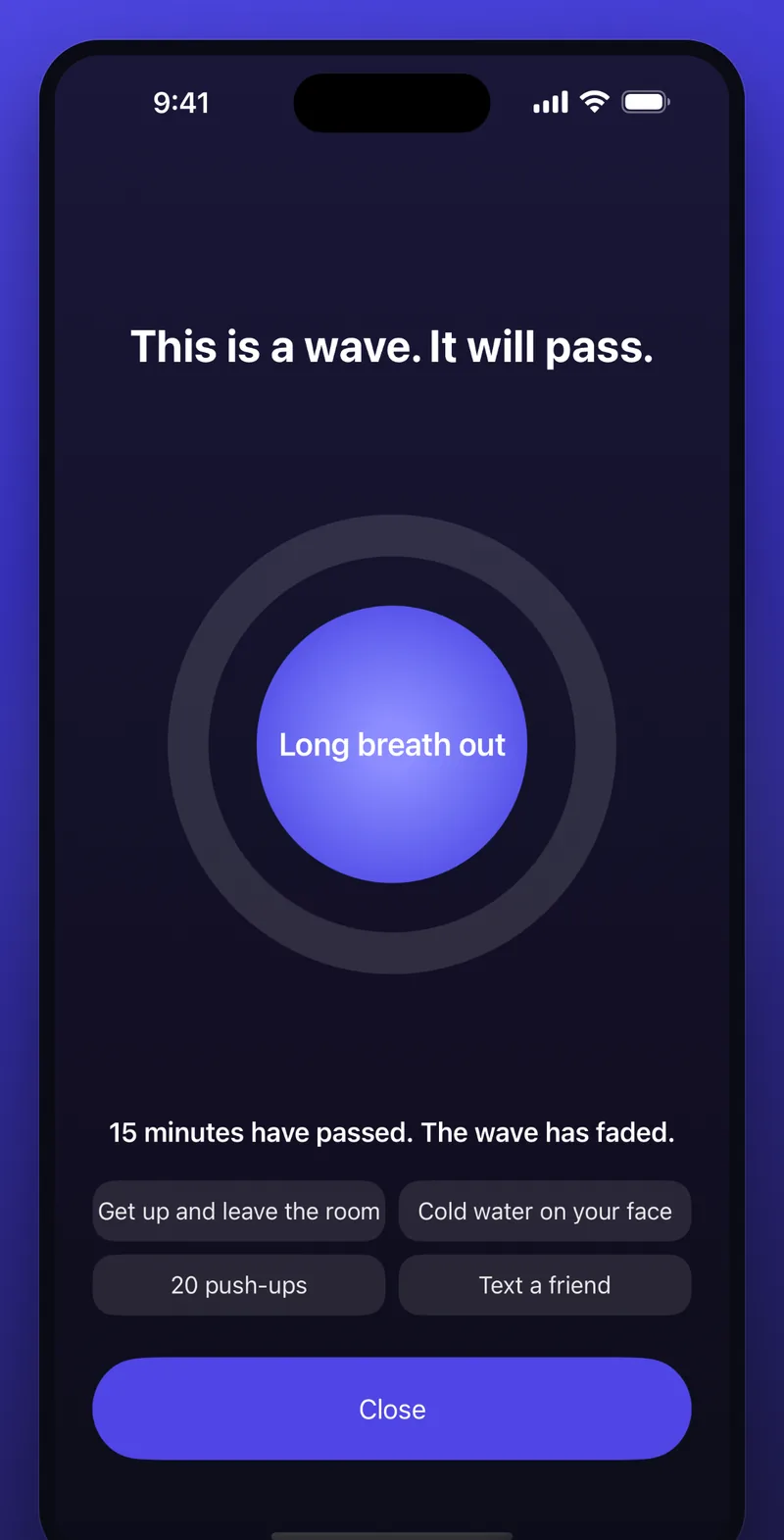
Seawall's block screen is built around exactly these steps. There is no lecture and no shame. The words say "This is a wave. It will pass." A circle breathes with you, growing on the inhale and shrinking on the long exhale. A countdown shows how long until the wave has faded, and four buttons name the small actions above. Then you close it and get on with your evening.
A caution
Urge surfing is a skill, and skills need practice at low stakes. Try it on small urges first: the reach for the phone at a red light, the second biscuit. If urges are frequent, escalating, or tied to shame that follows you into the next day, that is a reason to talk to a therapist who works with compulsive behaviour, not a reason to surf harder. A blocker and a breathing screen are tools. They are not treatment.
Practice tonight
Set a schedule block for the app that owns your late nights. When it fires, do not fight the screen. Breathe out, watch the wave, pick one small action. Fifteen minutes later, notice that you are still here and the urge is not.